 Skip to contentSkip to sidebarSkip to footer
Let’s be direct: losing belly fat fast doesn’t mean dropping ten pounds in a week or grinding out a thousand crunches a day. It means using the right strategies, ones that work with your metabolism, your hormones, and your actual schedule, so you get real results instead of spending months spinning your wheels.
Belly fat is one of the most frustrating things people deal with. And it’s not because people aren’t trying hard enough. It’s because a lot of what they’ve been told about how to lose belly fat fast is either incomplete or just wrong. The advice sounds plausible until it doesn’t work, and then you’re back to square one.
This guide covers why belly fat is so stubborn, which nutrition and exercise strategies actually move the needle, how fat burners can support your progress, and what lifestyle factors quietly sabotage results, so you can make smart decisions and start seeing changes.
Why belly fat is so hard to lose
Not all fat behaves the same way. Where your body stores fat, and how readily it gives it up, depends on biology, not willpower. Understanding that is half the battle.
The two types of belly fat
There are two distinct types of fat in the midsection. Subcutaneous fat sits just under the skin: soft, pinchable, the kind you can grab. Visceral fat is deeper, wrapping around your organs. Visceral fat is more metabolically active and more strongly linked to health risks like insulin resistance and cardiovascular disease.
Here’s the upside: visceral fat tends to respond faster to lifestyle changes than subcutaneous fat. When you start a structured fat-loss program, you’re often losing the more dangerous type first, even when you can’t see the change in the mirror yet.
Why your body holds on to it
Your body doesn’t see belly fat as a problem. It sees it as a protected energy reserve. Several hormonal mechanisms actively resist fat loss, particularly when you’re under-eating or over-stressed. Cortisol, the primary stress hormone, specifically drives fat storage in the abdominal region. Insulin resistance compounds the problem by making it harder for your body to access stored fat as fuel.
This is why crash diets rarely work long-term for belly fat. Severe caloric restriction tends to raise cortisol, slow metabolism, and trigger muscle loss, which is precisely what you don’t want. A smarter, more moderate approach consistently outperforms aggressive restriction.
The nutrition strategies that actually work
You can’t out-exercise a poor diet, especially when the goal is belly fat. Nutrition does most of the work.
Build a sustainable caloric deficit
A caloric deficit is non-negotiable for fat loss. There’s no workaround. But “as little as possible” is the wrong target. A moderate deficit of 300-500 calories per day consistently outperforms aggressive restriction in long-term studies, producing roughly 0.5-1 pound of fat loss per week without the muscle loss or metabolic slowdown that comes with starvation-level cuts.
Before adjusting anything, track your intake honestly for two weeks. Most people significantly underestimate how much they eat, particularly from cooking oils, condiments, and drinks.
Protein is your biggest ally
If there’s one dietary lever that makes more difference than any other, it’s protein. It keeps you fuller longer, requires more energy to digest (the thermic effect of food), and, most critically, preserves lean muscle mass during a caloric deficit. Muscle tissue burns more calories at rest, so protecting it directly supports your metabolism.
Aim for 0.7-1 gram of protein per pound of body weight. Good sources include:
- Chicken, turkey, and lean beef
- Eggs and egg whites
- Greek yogurt and cottage cheese
- Fish and shrimp
- Legumes and tofu for plant-based options
Getting enough protein is one of the most effective ways to improve body composition while losing weight. Most people aren’t close to their target.
Cut the biggest offenders first
You don’t need to overhaul your entire diet at once. Start with the foods and drinks that contribute the most empty calories and inflammatory load:
- Sweetened drinks (sodas, coffees, juices, alcohol) add hundreds of calories without making you feel full
- Ultra-processed snacks are engineered to override your satiety signals so you keep eating past fullness
- Refined carbs like white bread and pastries spike blood sugar and promote the insulin responses that drive fat storage
Pulling these back first, even partially, typically produces faster visible results than almost any other single change.



Exercise that actually moves the needle
Exercise is essential, but type matters. Doing more of the wrong thing won’t get you there faster.
HIIT vs. steady-state cardio
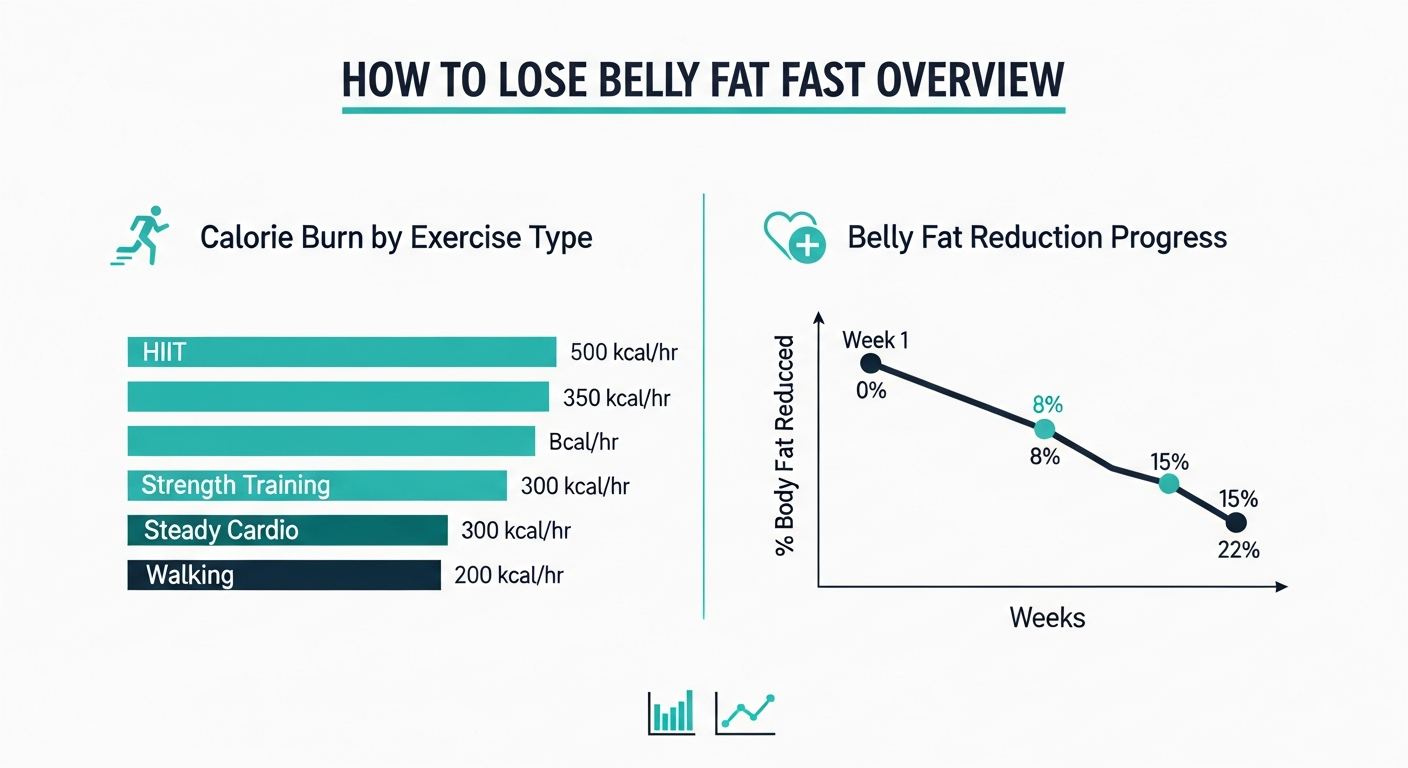
High-intensity interval training (HIIT) is one of the most studied approaches for fat loss. Sessions alternate between all-out effort and active recovery, and the physiological effect extends well past the workout itself. HIIT increases post-exercise oxygen consumption (EPOC), meaning your body continues burning calories at an elevated rate for hours afterward.
A 2021 meta-analysis found that HIIT was significantly more effective than moderate-intensity continuous exercise for reducing visceral fat specifically. Three 20-30 minute sessions per week can produce real results within 8-12 weeks. That said, steady-state cardio still earns its place. It builds cardiovascular capacity, supports recovery between harder sessions, and adds to your weekly calorie burn. Use both.
Why strength training is non-negotiable
Cardio burns calories during the workout. Strength training changes your body’s baseline. When you build muscle through resistance training, you increase your resting metabolic rate (the number of calories your body burns just to function). That means fat loss becomes faster and significantly easier to maintain.
Two to four strength sessions per week is the target. Compound movements (squats, deadlifts, rows, presses) do more metabolic work than isolation exercises. You don’t need to lift heavy from day one. Progressive overload over time is what drives the adaptation. And no, lifting won’t make you “bulky.” What it will do is make losing belly fat considerably easier.
How fat burners can accelerate your results
Fat burners aren’t magic, and they’re not meant to replace the fundamentals above. But when your diet and training are in place, the right supplement can noticeably accelerate your results and make the process a lot more manageable.
What they do (and don’t do)
A science-backed fat burner works through a few key mechanisms:
- Thermogenesis: a slight increase in body temperature that raises daily calorie burn
- Appetite suppression: blunting hunger signals so the deficit is easier to hold
- Energy support: countering the fatigue that comes with eating less
- Metabolism support: helping your body pull from stored fat for fuel instead of muscle
What they don’t do is override a poor diet, eliminate the need to exercise, or produce results on their own. Think of them as an accelerant, not a replacement for the work.
Key ingredients that make the difference
Not all fat burners are formulated the same. The ones that work share a few common, well-researched compounds:
- Green tea extract (EGCG): 200-400mg per day has been shown to increase fat oxidation and support thermogenesis
- Caffeine: a proven thermogenic and performance enhancer that also improves workout output
- L-carnitine: helps transport fatty acids into mitochondria where they’re burned for energy
- Capsaicin: the active compound in chili peppers, shown to boost metabolism and cut appetite
- Chromium picolinate: supports blood sugar regulation and reduces carb cravings
When evaluating any fat burner, check the label for these ingredients with actual doses listed. Proprietary blends that hide individual amounts are a red flag.
Timing matters too. Taking a fat burner 20-30 minutes before a workout, or first thing in the morning on an empty stomach, typically produces the best results. Most formulas work best when cycled: 8-12 weeks on, then a 2-4 week break to prevent tolerance buildup.
At Vioxid, our fat burning products use clinically relevant doses, not underdosed ingredients buried in proprietary blends, and they’re designed for real people following real routines.
Lifestyle factors most people overlook
Diet and exercise do the heavy lifting. But these two factors quietly undermine results for a lot of people, and they’re both fixable.
Stress, cortisol, and belly fat
Chronic stress is one of the most underappreciated drivers of abdominal fat. When cortisol stays elevated long-term, your body stores more fat in the midsection, breaks down muscle tissue, and signals increased hunger, particularly for high-calorie, high-carbohydrate foods. It’s a survival response, and modern life triggers it constantly.
Managing stress isn’t soft advice. It’s physiology. Regular walks, breathwork, pulling back on excessive caffeine, setting clearer work boundaries, and actually taking downtime all measurably reduce cortisol levels. These habits are as important to fat loss as what you eat.
Sleep more, lose more
Research from the University of Chicago found that people sleeping 8.5 hours per night lost significantly more body fat than those sleeping 5.5 hours, even when caloric intake was identical. Sleep deprivation raises ghrelin (the hunger hormone), lowers leptin (the satiety hormone), and increases cortisol. It also tanks workout performance and recovery.
Seven to nine hours per night isn’t optional when fat loss is the goal. You can optimize your diet and training perfectly and still stall out if you’re chronically under-recovered. That’s how much it matters.
How long does it really take?
| Approach | Weekly fat loss | Results visible | Muscle preserved | Sustainable |
|---|---|---|---|---|
| Crash diet (<1,000 kcal/day) | 2-4 lbs | 1-2 weeks | No | No |
| Deficit only, no exercise | 0.5-1 lb | 4-6 weeks | Partially | Sometimes |
| Deficit + cardio only | 0.5-1.5 lbs | 3-5 weeks | Partially | Yes |
| Deficit + strength + HIIT | 1-1.5 lbs | 2-4 weeks | Yes | Yes |
| Deficit + training + fat burner | 1-2 lbs | 2-3 weeks | Yes | Yes |
There’s no honest version of how to lose belly fat fast that involves zero weeks of consistent effort. But with the right combination of a moderate deficit, strength training, HIIT, and quality supplementation, you can expect real changes in 3-4 weeks and significant results by weeks 8-12. The people who get the best results are the ones who stop hunting for shortcuts and start stacking small, consistent wins instead.
Frequently asked questions about how to lose belly fat fast
When it comes to losing belly fat, the same questions come up again and again. Here are honest, evidence-based answers to the ones we hear most.
Can you target belly fat with specific exercises?
Spot reduction is a myth. You can’t choose where your body burns fat by exercising that area specifically. However, visceral belly fat does tend to respond faster to diet and exercise than stubborn subcutaneous fat elsewhere. A caloric deficit is what drives fat loss; exercise accelerates it and shapes your body composition along the way.
How much cardio should I do to lose belly fat fast?
Three to five sessions per week is a solid starting point. Mixing HIIT (2-3 sessions) with moderate steady-state cardio (1-2 sessions) gives you the fat-burning benefit of high intensity without overtraining. Don’t sacrifice sleep or strength training to add more cardio. That trade-off typically backfires.
Do fat burners actually work?
Yes, when they’re well-formulated and used alongside a caloric deficit and exercise. Fat burners with evidence-backed ingredients like green tea extract, caffeine, and L-carnitine have been shown to increase fat oxidation, thermogenesis, and energy levels. They’re supplements, not substitutes.
Is belly fat the last place you lose it?
For most people, yes. Where fat goes on first tends to be where it comes off last. If your midsection is your primary problem area, you may need to get leaner overall before belly fat fully clears. That’s a normal biological reality, and it’s why patience and consistency matter more than intensity.
What foods are worst for belly fat?
Liquid sugar (sodas, sweetened coffees, juices, alcohol), ultra-processed snacks, refined carbohydrates, and trans fats consistently promote abdominal fat accumulation. These foods spike blood sugar, drive insulin responses, and are engineered to be easy to overeat. Pulling them back makes one of the biggest early differences.
How important is sleep for losing belly fat fast?
Extremely important. More than most people realize. Sleep deprivation elevates cortisol, disrupts hunger and satiety hormones, and reduces your body’s capacity to recover and perform. Getting 7-9 hours per night is one of the most overlooked steps you can take for faster fat loss.
The moves that actually work
Losing belly fat fast doesn’t require extreme measures. It requires the right moves, applied consistently enough to compound into real results.
Start with a moderate caloric deficit and hit your protein targets. Add strength training and HIIT. Protect your sleep and actually manage your stress. When you’re ready, a quality fat burner can support your metabolism and make the whole process less of a grind. That’s the blueprint, and it works for real people with real schedules, not just athletes with six hours a day to train.
At Vioxid, we build our products to fit into this system, not replace it. Explore our full range of science-backed fat burning products at vioxid.com.

Andrew Crawford is a certified fitness coach and founder of Vioxid, helping over 10,000 readers reach their weight loss goals.

